What Is Generative Engine Optimization (GEO)?
If you’ve noticed that more of your customers are starting their research by asking ChatGPT, Perplexity, or Google’s AI Overviews a question instead of typing keywords into a search bar, you’re watching a fundamental shift in how people find businesses online. Understanding what is Generative Engine Optimization — and how it differs from traditional SEO — is quickly becoming essential for any business that wants to stay visible as search behavior evolves. At Local Blitz, we’ve been navigating the changing landscape of digital marketing since 2009, and GEO is the most significant shift we’ve seen in how brands earn visibility online. Here’s what it is, why it matters, and what small businesses need to do about it now.
GEO Is the Practice of Getting Your Business Cited by AI Search Platforms
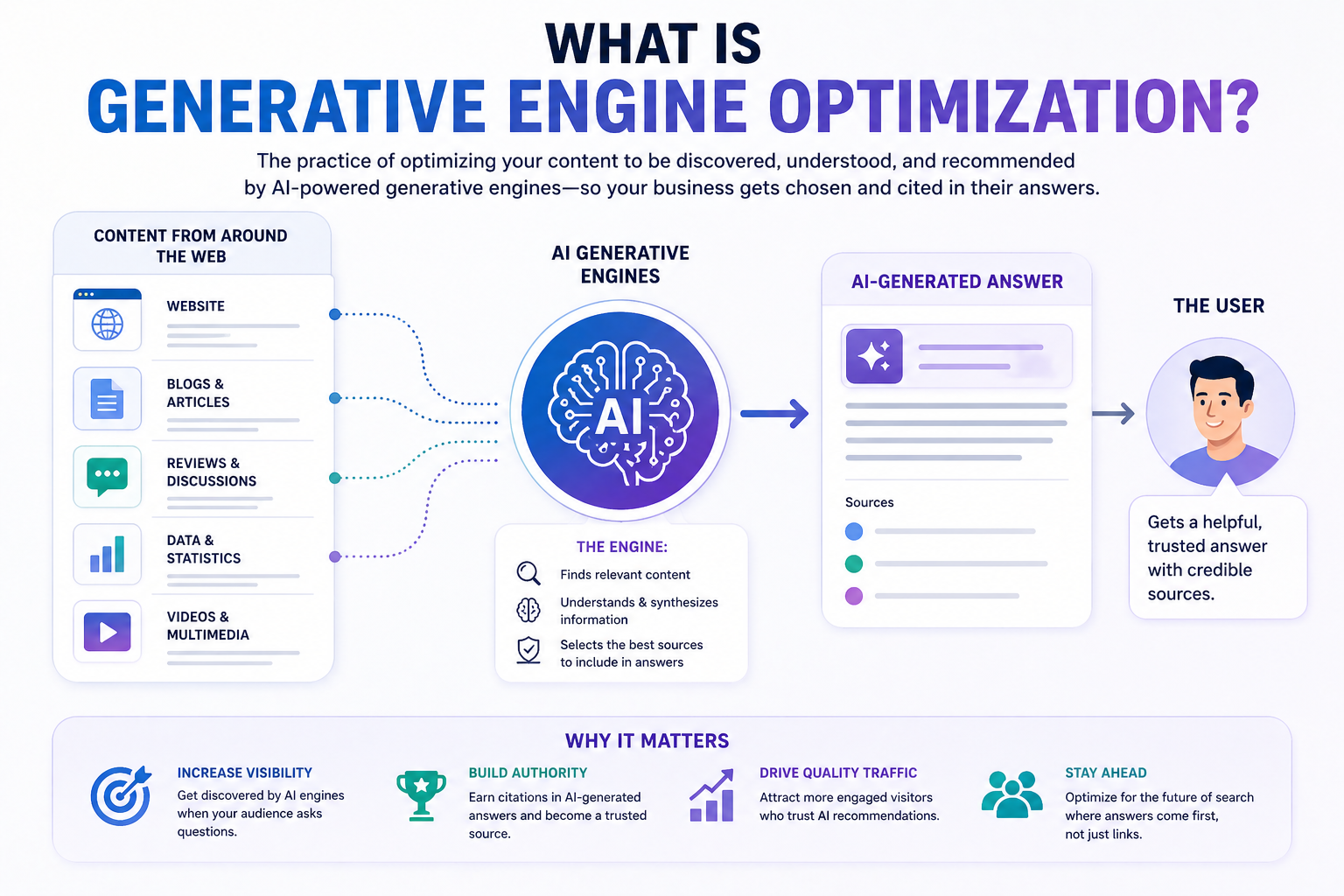
Generative Engine Optimization — GEO — is the practice of structuring and presenting your content so that AI-powered search platforms recommend, cite, or reference your business when answering user questions. While traditional SEO gets your website ranked on a Google results page, GEO gets your brand included in the answer that ChatGPT, Perplexity, Google AI Overviews, or other large language models generate when someone asks a question in natural language.
The distinction matters because these two outcomes are fundamentally different. In traditional search, a user sees a list of ten blue links and chooses which one to click. In AI-generated search, the user receives a synthesized answer — and your brand either appears as a cited source within that answer, or it doesn’t exist in that interaction at all. There is no page two. There is no position seven. There is cited, and there is invisible.
This shift is already happening at scale. ChatGPT reached 800 million weekly active users by late 2025, doubling in less than a year. AI-referred traffic to business websites jumped dramatically year-over-year as more users shifted their initial research to AI platforms. More than 70% of Americans now use AI tools to research purchases or evaluate businesses before making a decision. GEO is the discipline of making sure your business shows up in those moments.
How GEO Differs From Traditional SEO — and Why You Still Need Both
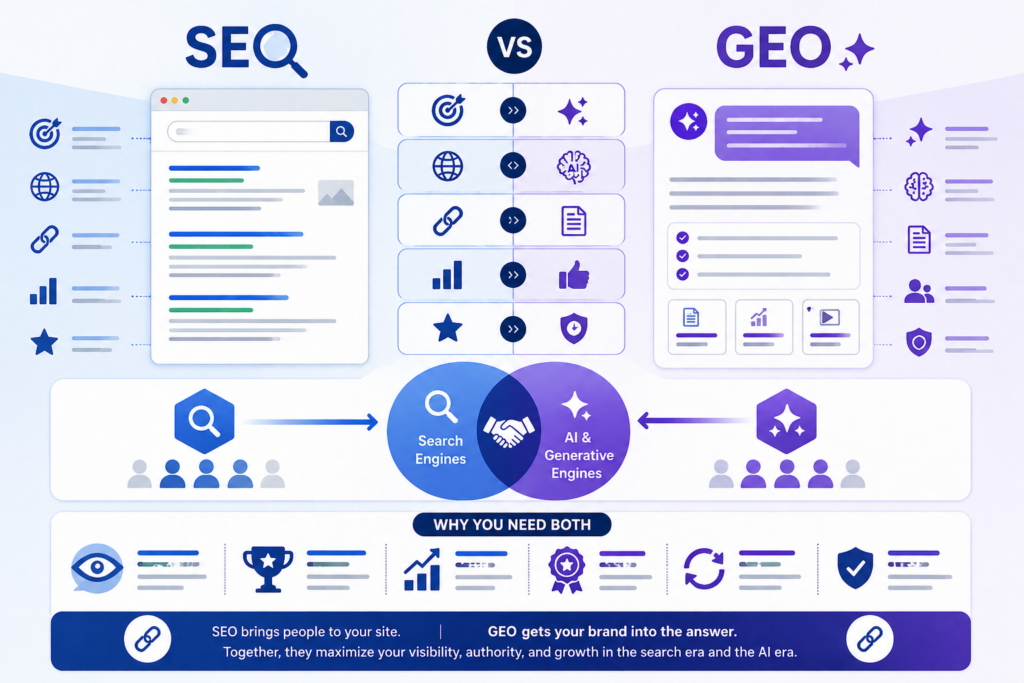
The most important thing to understand about GEO is that it doesn’t replace SEO — it extends it. Traditional SEO remains essential, and the fundamentals that have always mattered — authoritative content, technical site health, backlinks, and local signals — continue to influence visibility in both traditional and AI-generated search. But GEO adds a new layer of optimization that traditional SEO alone doesn’t address.
Here’s how the two disciplines differ in practice:
| Factor | Traditional SEO | Generative Engine Optimization (GEO) |
|---|---|---|
| Goal | Rank high in Google search results | Get cited in AI-generated answers |
| Primary signal | Keywords, backlinks, technical performance | Content authority, structure, factual density |
| Success metric | Search ranking position, organic clicks | Brand mentions and citations in AI responses |
| Content format | Keyword-optimized pages and blog posts | Direct-answer content with clear structure and cited facts |
| Key platforms | Google, Bing | ChatGPT, Perplexity, Google AI Overviews, Gemini, Claude |
| Traffic outcome | User clicks through to your website | User absorbs your brand in the answer, may or may not click through |
The businesses that win in the next few years will be the ones running both disciplines simultaneously — maintaining strong traditional SEO while actively optimizing for AI citation. Ignoring either one leaves visibility on the table.
Why AI Search Platforms Choose to Cite Some Businesses and Not Others
AI language models don’t pull citations randomly. They draw on content that meets specific criteria — and understanding those criteria is the foundation of an effective GEO strategy. Here’s what determines whether your content gets included in AI-generated answers:
Authoritativeness and Trustworthiness (E-E-A-T)
Google’s E-E-A-T framework — Experience, Expertise, Authoritativeness, and Trustworthiness — has been a traditional SEO signal for years, but it plays an even more central role in GEO. AI platforms are designed to cite credible, accurate sources. Content that demonstrates real expertise, is attributed to knowledgeable authors, references reputable external sources, and is consistent with what the broader web says about a topic is significantly more likely to be cited than generic content with no demonstrated authority behind it. For local businesses, this means the depth and authenticity of your content matters more than ever.
Content Structure and Direct Answering
AI systems are built to extract and summarize information efficiently. Content that is clearly structured — with descriptive headings, short paragraphs, bullet points, and answers that appear directly at the top of a section rather than buried mid-paragraph — is far easier for AI models to parse and cite. Content with a direct answer in the first 40 to 60 words of each section performs measurably better in AI search visibility than content that buries its point after several sentences of preamble.
Factual Density and Cited Statistics
AI platforms favor content that contains verifiable facts, specific numbers, and cited data. Vague, opinion-heavy content without supporting evidence is harder for AI systems to cite confidently because it can’t be verified against other sources. Content that includes concrete statistics — with attribution — gives AI models something specific and credible to reference. This is one of the most actionable GEO improvements a business can make to existing content without a full rewrite.
Schema Markup and Structured Data
Schema markup is the technical language that helps both search engines and AI platforms understand what your content is about. FAQ schema, Article schema, LocalBusiness schema, and Service schema all help AI systems correctly interpret and categorize your content. Research indicates that content with proper schema markup shows significantly higher AI visibility than the same content without it — making schema implementation one of the highest-ROI technical GEO investments available.
Brand Presence Across the Web
AI models synthesize information from many sources. The more consistently your business name, expertise, and key messages appear across authoritative third-party sources — review platforms, industry directories, press mentions, guest content, and local citations — the more AI systems “know” about your brand and the more confidently they can reference it. This makes traditional reputation management and PR activities relevant to GEO in ways they weren’t directly relevant to traditional SEO.
What GEO Means Specifically for Local Businesses
For local service businesses in Indianapolis, San Diego, and other competitive markets, GEO introduces both a challenge and a significant opportunity. The challenge is that local businesses often have thinner content footprints than larger brands — fewer blog posts, less structured data, and lower third-party citation volume. The opportunity is that the majority of local competitors are not yet actively optimizing for AI search, which means there is a first-mover advantage available right now for businesses willing to invest in GEO before it becomes as crowded as traditional SEO.
When a potential customer in Indianapolis asks ChatGPT “who are the best digital marketing agencies in Indianapolis?” or “what should I look for in a local SEO company?”, the businesses that appear in that answer have a meaningful edge. They’re not just visible — they’re being recommended by the AI the user chose to trust with their question. That level of implied endorsement is worth competing for.
For local businesses specifically, these GEO actions deliver the most impact:
- Comprehensive Google Business Profile optimization — AI platforms that pull local data frequently reference Google Business Profiles. A complete, regularly updated profile with photos, detailed service descriptions, and current reviews provides AI systems with reliable, structured data about your business.
- FAQ-structured content on service pages — Adding clearly formatted FAQ sections to your service and location pages provides AI models with direct-answer content in exactly the format they prefer to cite.
- Review volume across multiple platforms — AI systems synthesize signals from Google, Yelp, Facebook, and industry-specific platforms. Consistent review volume across multiple platforms strengthens the AI’s confidence in recommending your business.
- Local content that demonstrates community expertise — Blog posts, guides, and resources that address locally relevant questions — specific to your city, your service area, or your industry in your market — help AI platforms recognize your business as a credible local authority rather than a generic service provider.
How to Start Building a GEO Strategy Today
GEO is not a one-time project — it’s an ongoing discipline, just like SEO. But there are concrete starting points that deliver measurable impact relatively quickly:
- Audit your current AI visibility — Search your business name, your service category, and your key service questions in ChatGPT and Perplexity. Note whether your business appears, how it’s described, and whether the description is accurate. This baseline tells you where you stand today.
- Restructure existing content for direct answers — Review your highest-traffic pages and blog posts. Add descriptive H2 and H3 headings. Move the direct answer to the top of each section. Break long paragraphs into shorter ones. Add FAQ sections with explicitly structured questions and answers.
- Implement schema markup on key pages — Add FAQ schema to blog posts and service pages, LocalBusiness schema to your homepage and contact page, and Article schema to blog content. Google’s Structured Data Helper and Schema.org provide free tools for generating this markup.
- Build third-party authority — Prioritize getting your business accurately listed and regularly reviewed on authoritative third-party platforms: Google Business Profile, industry associations, local chambers of commerce, and reputable directory sites. These off-site signals contribute to the AI’s confidence in citing your brand.
- Create content that answers the questions your customers ask AI — Think about the specific questions someone in your market would type into ChatGPT before hiring your type of business. Create or update content that answers those questions directly, completely, and with cited supporting evidence.
At Local Blitz, we work with businesses in Indianapolis and San Diego that want to stay ahead of where search is going — not scramble to catch up after competitors have already claimed the AI-search real estate in their market. If you want to understand where your business currently stands in AI search visibility and what a practical GEO strategy would look like for your specific industry and market, call our Indianapolis office at (317) 672-1156 or our San Diego office at (858) 225-6877. We’re happy to have that conversation.
Frequently Asked Questions About Generative Engine Optimization
Does GEO replace SEO for small businesses?
No — GEO extends SEO rather than replacing it. Traditional search on Google and Bing still drives significant traffic, and the technical and content fundamentals of strong SEO directly support GEO performance as well. The businesses best positioned for AI search visibility today are the ones that already have strong SEO foundations. GEO adds a new layer of optimization on top of that foundation — it doesn’t make the foundation irrelevant.
How do I know if my business is being mentioned in AI search responses?
The most direct method is to manually query platforms like ChatGPT, Perplexity, and Google AI Overviews with questions your target customers would ask — including your business name and your service category in your city. Emerging AI monitoring tools from platforms like Semrush, BrightEdge, and others also offer AI visibility tracking. Establishing a regular monitoring cadence is important because AI responses shift as models are updated and new content enters their training data.
How long does it take to see results from GEO optimization?
GEO timelines vary by platform and by how aggressively your competitors are also optimizing. Structural content improvements and schema markup implementations can show impact within weeks on platforms like Perplexity that index and update frequently. Citation authority built through third-party reviews and brand mentions compounds over time, similar to how link-building compounds in traditional SEO. Because GEO is still relatively early in adoption, businesses that start optimizing now are building a lead before the space becomes as contested as traditional SEO.
Is GEO relevant for local service businesses, or just large brands?
GEO is highly relevant for local service businesses. When potential customers ask AI platforms for recommendations — “best plumber in Indianapolis,” “top web design agency in San Diego” — the businesses that appear in those answers have a direct advantage in converting that inquiry into a lead. Local GEO optimization through Google Business Profile, local content, and structured review presence is accessible to small businesses and doesn’t require the large content budgets that enterprise GEO programs demand.
What is the difference between GEO and AEO (Answer Engine Optimization)?
AEO (Answer Engine Optimization) is an earlier term for optimizing content to appear in direct answer features — such as Google’s featured snippets and People Also Ask results — within traditional search. GEO encompasses AEO but extends it specifically to the newer generation of large language model platforms like ChatGPT, Perplexity, and Google’s AI Mode. In practice, the content strategies for both overlap significantly: structured content, direct answers, factual density, and schema markup serve both disciplines simultaneously.