What Should Be Included in a Small Business Website?
A small business website should include, at minimum, five things: a clear homepage that explains what you do, an easy-to-find contact page, a services or products page, an about page that builds trust, and a mobile-friendly, secure (HTTPS) design. Everything else—reviews, a blog, analytics—strengthens those foundations but doesn’t replace them. If you’re mapping out the small business website essentials before you build or refresh your site, this guide walks through what each element does and why it matters.
At Indianapolis Web Design Company, we build sites for local service businesses, shops, and growing companies, and the same pattern holds every time: the businesses that win online aren’t the ones with the flashiest design. They’re the ones whose site quickly answers a visitor’s three silent questions—what is this, can I trust them, and how do I take the next step. Here’s how to make sure your website does exactly that.
Every Small Business Website Needs These Five Core Pages
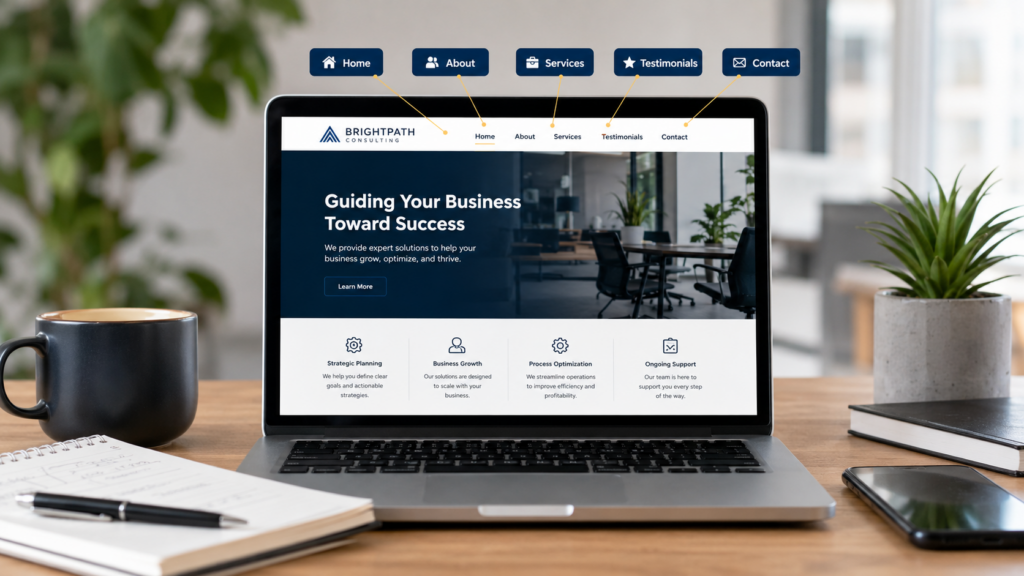
Before you think about extras, get the foundation right. These five pages cover what nearly every small business website needs to function, build credibility, and generate leads:
| Page | What It Does | Priority |
|---|---|---|
| Homepage | Communicates your value and points visitors to the next step | Essential |
| Services / Products | Explains what you offer and converts interest into action | Essential |
| About | Builds trust and puts a human face on your business | Essential |
| Contact | Makes it easy to reach you through multiple methods | Essential |
| Privacy Policy / Terms | Covers basic legal compliance and signals trustworthiness | Recommended |
Start here, launch, and then add depth—testimonials, a blog, individual service pages—as your business grows. A focused five-page site that loads fast beats a sprawling one that confuses visitors.
Your Homepage Has Seconds to Make Its Case
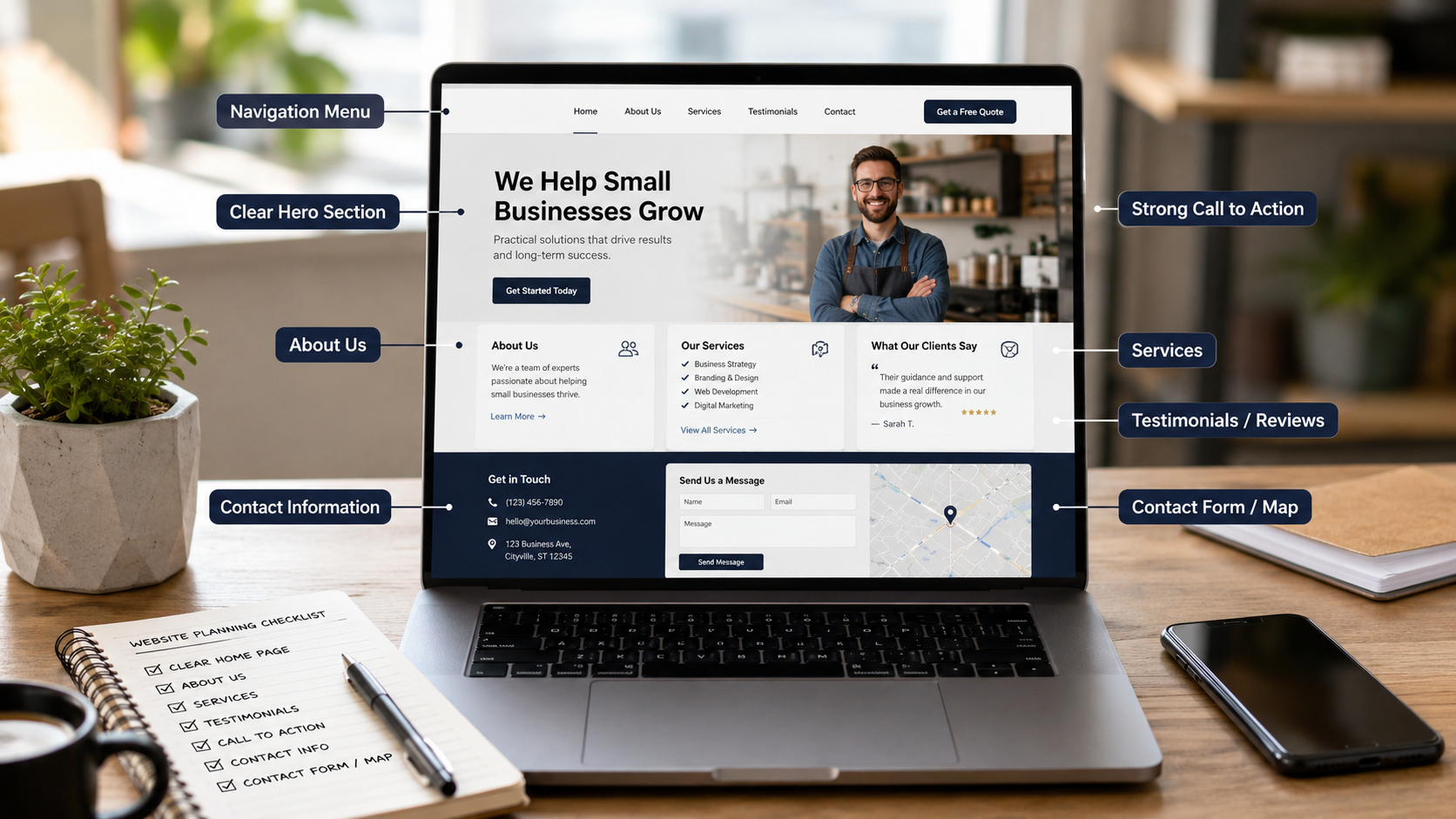
Your homepage is the single most important page on your site, because most visitors decide within a few seconds whether to stay. It should answer three questions immediately: what you do, who you serve, and why someone should choose you. Everything above the fold should work toward that.
A strong small business homepage includes:
- A clear headline stating what you do in plain language—no jargon or vague slogans.
- A visible call to action like “Get a Free Quote” or “Call Us,” placed near the top.
- Your phone number in the header, ideally click-to-call on mobile.
- Two or three proof points—reviews, years in business, or recognizable clients.
- Simple navigation with five to seven menu items, not twenty.
If a stranger can’t tell what your business does and how to contact you within a few seconds of landing, the homepage needs work—no matter how nice it looks.
Contact Options Should Be Obvious on Every Page
The fastest way to lose a ready-to-buy customer is to make them hunt for how to reach you. Your contact details should appear in the header or footer of every page, plus a dedicated contact page that offers several ways to connect. People reach out differently, so give them options.
Include at least these on your contact page:
- A short contact form (name, email, and message—keep it to three or four fields).
- A clickable phone number and an email address.
- Your business address with an embedded map if you have a physical location or service area.
- Your hours, and a note on how quickly you typically respond.
For Indianapolis businesses that serve specific neighborhoods or surrounding areas, list your service area clearly. It reassures local customers and helps you show up in local searches.
What Builds Trust on a Small Business Website?
Trust is what turns a visitor into a customer, and it comes from a handful of credibility signals working together. New visitors don’t know you yet, so your website has to earn their confidence quickly. The most effective trust-builders are:
- Customer reviews and testimonials—specific results carry far more weight than generic praise.
- A genuine about page with real names, photos, and the story behind your business.
- An HTTPS (SSL) secure connection, shown by the padlock in the browser bar.
- A portfolio or gallery of past work, especially for visual or service businesses.
- Credentials like certifications, awards, or local affiliations, displayed honestly.
You don’t need all of these at launch, but every one you add lowers the perceived risk of choosing you over a competitor.
Does a Small Business Really Need a Blog?
A blog isn’t mandatory, but for businesses that want to grow through search, it’s one of the highest-return additions you can make. Regularly published, helpful articles give search engines fresh content to index and answer the exact questions your customers are typing into Google. Over time, that builds your visibility without paid ads.
If you commit to a blog, focus on quality over volume. A handful of thorough, genuinely useful posts that answer real customer questions will outperform dozens of thin ones. Link each post to a relevant service page so readers have a natural next step, and update older posts periodically to keep them accurate.
Technical Must-Haves: Mobile, Speed, and Analytics
The best content fails if the technical foundation is weak, so three non-negotiables sit beneath everything else. Most of your visitors will arrive on a phone, and Google evaluates the mobile version of your site first. Get these right:
- Mobile-responsive design—your site must adapt cleanly to phones and tablets, not just desktops.
- Fast loading—compress images and choose solid hosting; visitors abandon slow pages quickly.
- Analytics tracking—install Google Analytics so you can see what’s working and what isn’t.
Test your site on an actual phone, not just a shrunken browser window. If forms, buttons, and menus aren’t easy to tap and read on mobile, you’re losing customers before they ever reach your content.
Frequently Asked Questions About Small Business Websites
How many pages does a small business website need?
Most small businesses do well with five to eight pages at launch: home, about, services or products, contact, and a privacy policy, plus a blog or portfolio if relevant. It’s better to start lean and add pages as you grow than to launch with thin, half-finished content. Quality and clarity matter more than page count.
Do I need a blog if I run a small local business?
You don’t need one to launch, but a blog helps a great deal if you want to rank in local search and answer common customer questions. Even one helpful post per month, focused on what your customers actually ask, can improve your visibility over time. If you can’t maintain it consistently, it’s better to skip it than to leave it stale.
What makes a website look professional?
A professional look comes from consistency and clarity more than expensive graphics: a clean layout, readable fonts, consistent colors that match your brand, quality images, and no broken links or typos. Fast loading and a secure HTTPS connection also signal professionalism. Visitors notice when a site feels polished and trustworthy, even if they can’t say why.
How important is mobile design for a small business website?
It’s essential. The majority of web traffic now comes from mobile devices, and Google primarily uses the mobile version of your site for ranking. A site that’s hard to use on a phone will frustrate visitors and hurt your search visibility, so mobile-friendly design is a baseline requirement, not an upgrade.
Should I include pricing on my website?
If you can, showing pricing or at least ranges helps filter out poor-fit inquiries and builds trust with serious prospects. Many people skip businesses that hide pricing entirely. If exact pricing isn’t practical, a “starting at” figure or a brief explanation of what affects cost still goes a long way.
Building a Website That Works for Your Business
A great small business website isn’t about having every possible feature—it’s about getting the essentials right so visitors understand what you offer, trust you, and know how to take the next step. Start with the five core pages, make sure they work flawlessly on mobile, and add depth as your business grows.
If you’d like a website that covers all of these essentials without the guesswork, the team at Indianapolis Web Design Company can help you plan and build one that fits your goals and budget. Call us at (317) 653-6567 to talk through what your site needs and where to focus first.